Conflict training
“Conflict competence begins long before a conflict escalates.”
- How is conflict competence developed within your organisation?
- What approach do managers and teams need to adopt when dealing with conflicts?
- When should leaders consciously let conflicts run their course – and when should they intervene?
- How can a conflict lead to growth rather than escalation?
Conflict competence can be developed. Our training programs support leaders and teams in recognising conflicts at an early stage, addressing them professionally and resolving them constructively. They combine the right mindset, reflection and tried-and-tested tools and methods to help participants manage conflicts confidently and gain confidence in dealing with difficult situations.
Our understanding of conflict competence:
Conflicts are part of everyday working life. Wherever people work together, different perspectives, interests and expectations come together – and so, inevitably, do conflicts. For us, conflict competence means recognising such situations at an early stage, putting them into context and managing them effectively. Our training programs combine well-established models, tried-and-tested methods and practical tools with in-depth reflection and realistic exercises. In this way, managers and teams develop confidence in dealing with conflicts and strengthen their ability to act clearly, confidently and effectively, even in challenging situations.
Our training programs are built around our Conflict Navigation Framework. It describes the journey from recognising a conflict, through analysing it, to addressing and resolving it. A key element of our training programs is learning to distinguish between conflicts in which I am personally involved and those I am responsible for managing in my role as a leader. These two situations differ in terms of role and responsibility and – depending on the context – require different priorities, approaches and tools.
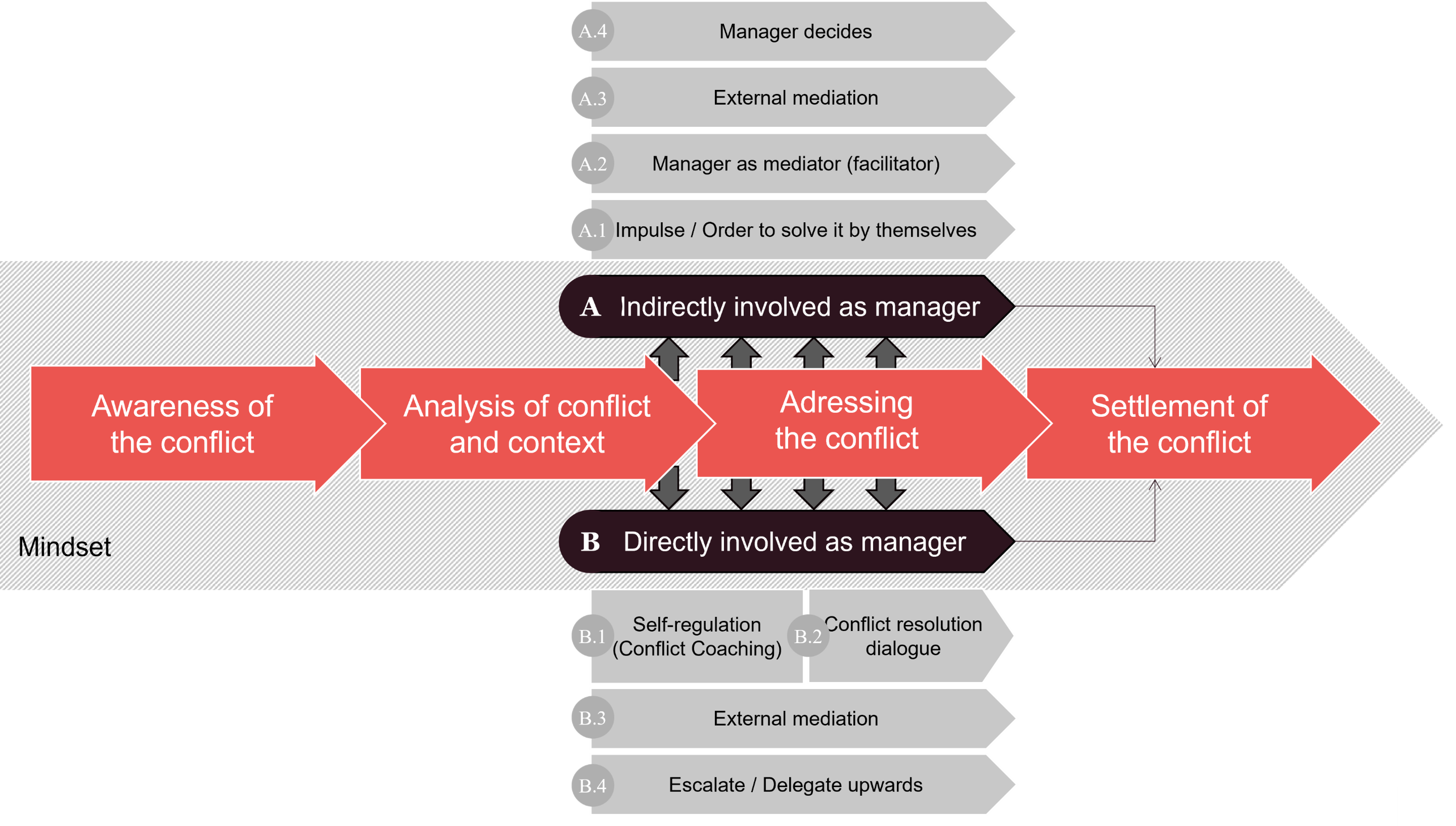
The Conflict Navigation Framework forms the basis for our training programs. It helps managers and staff to analyse conflicts systematically, to be mindful of their own role and to decide, in a manner appropriate to the situation, which approach is most appropriate. This provides guidance – from the initial recognition of a conflict right through to its resolution.
Depending on the target group, the task at hand and the timeframe, we develop bespoke training programs.
Typical focal points of our conflict training courses are:
Conflict management is a leadership responsibility
Recognising, assessing and professionally managing conflicts within a team is one of the core responsibilities of leadership. In this training, managers learn when to observe carefully, when to encourage independent conflict resolution, and when they should take action themselves. They are provided with a clear framework for guidance, tried-and-tested tools and practical conversation frameworks to manage conflicts appropriately for each situation – from the initial recognition right through to facilitation or a necessary management decision.
Taking Action in Conflict
Anyone who is personally involved in a conflict first needs clarity about their own situation. In this training course, participants learn to reflect systematically on conflicts, to distinguish between perceptions and interpretations, to identify interests and needs, and to prepare specifically for difficult conversations. Using tried-and-tested methods and practical tools, they develop confidence in dealing with conflicts and strengthen their ability to act clearly, confidently and effectively, even in challenging situations.
Embracing conflict
Understanding yourself. Understanding others. Making the most of conflicts.
In conflicts, we are often surprised by the behaviour of others – and sometimes even by our own. In this interactive workshop, teams explore in a playful way how conflicts arise, what patterns influence them, and what drives people in difficult situations. Participants reflect on their own values, needs and typical reactions, gain a deeper understanding of their colleagues' different ways of thinking and reacting and, together, develop a deeper understanding of how to manage tension. Self-reflection, mutual understanding and humour create an atmosphere in which learning comes easily and trust grows.
Objective: To reduce the unpredictability of conflicts and strengthen the team’s ability to navigate tensions with clarity, ease and trust.