360° Feedback for Leaders and Key Roles
- Are our leadership principles already being put into practice? To what extent do employees feel that their skills are recognized and that they are supported in their daily work?
- How are leaders, project managers, or key personnel perceived by our most important stakeholders and partners?
- What should be considered to ensure that feedback providers can give feedback in a climate of trust and in a way that is helpful to the recipients? In terms of design, communication, and implementation?
- In what process does multi-perspective feedback (180°, 270°, or 360° feedback) achieve its full impact?
In 180°, 270°, and 360° feedback, we survey employees, supervisors, colleagues, and, where relevant, customers regarding relevant behavioral aspects of a manager, project manager, or employee in a specific role. This is because multi-perspective feedback doesn’t just help leaders advance—it’s suitable for all employees whose individual development benefits from feedback from various perspectives. The diversity of perspectives provides feedback recipients with particularly rich insights into their own behavior and the impact they have on others.
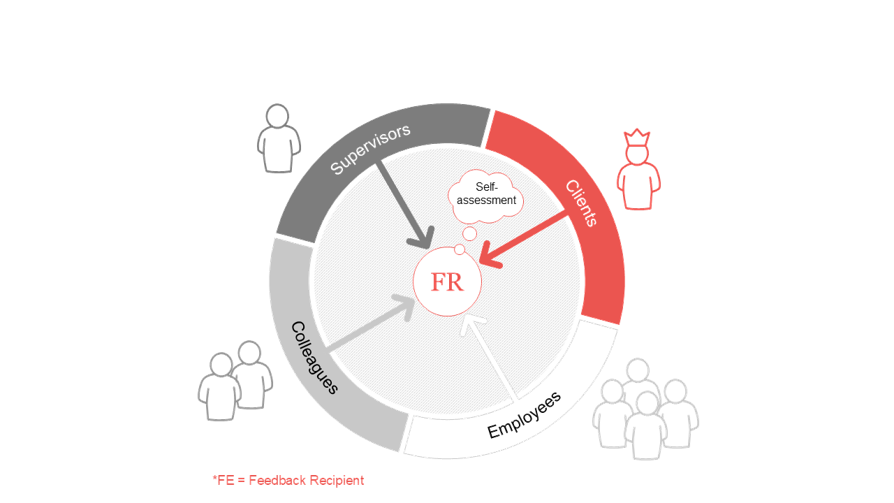
Figure: Feedback Model
Our Tools & Methods
Based on our many years of experience and expertise, we at 5P Consulting draw on a broad spectrum of survey tools. This enables us to offer the right solution for every target group and every focus area—whether it involves aligning with established leadership models (5P Growth Leadership, Transformative Leadership, Positive Leadership), incorporating your specific corporate values, or using scientifically validated question sets with benchmarking capabilities. To this end, we collaborate with SHL, a leading global provider of psychometric assessment tools, among others.
We successfully employ three types of 360° feedback processes:
- Quantitative: A web-based survey that quickly gathers feedback from many people about a leader or someone in a key role
- Qualitative: Selected individuals provide nuanced feedback on impact and observable behavior in confidential one-on-one conversations
- Integrated: Quantitative and qualitative methods are combined
In addition, upon agreement, we use AI trained for surveys, which serves as a virtual interviewer during the survey and efficiently provides expanded insights during the analysis. (Link to Antonia)
Our 360° feedback process is designed as a development tool
- that provides valuable feedback on perceived competencies and one’s own impact
- whose results serve as the basis for fostering more effective collaboration
- whose summarized results can provide HR/management with insight into existing competencies within the company and guidance for planning development needs
- that highlights the potential for optimization at internal interfaces or throughout the entire service chain
- he successful implementation of which contributes to the further development of an open and trusting leadership and corporate culture
At the same time, however, it is also a significant intervention, which must be taken into account during preparation, communication, and careful implementation in order to clarify expectations and address them appropriately in follow-up processes.
Process
1. Design & Preparation (1 to 4 weeks):
Together, we define the specific survey topics—tailored to your company’s values or based on scientific standards. We set up the survey and feedback-provider structure in the survey tool and coordinate the preliminary information for all stakeholders through participants and HR/management.
2. Survey Implementation (1 to 3 weeks):
We conduct the survey using a web-based tool; optionally, we integrate qualitative interviews and provide support for feedback providers as well as information on response rates.
3. Analysis & Reports (1 week):
We analyze the collected data, create individual and group reports, and present the results.
4. Feedback & Actions (1 to x weeks):
We conduct individual feedback sessions, develop specific development recommendations, facilitate development discussions, and support participants in working with the results.
The Survey
The survey is the first milestone in a longer process in which trust, communication skills, and—last but not least—impact play a central role.
1. Content-Related Questions
Based on existing systems (competency matrix, evaluation systems, values, mission statement, leadership principles, etc.) or established leadership models, what specific feedback should be provided?
Using our various survey tools, we select the set that aligns with your goals—whether individually tailored to your company’s values or as a standardized, scientifically sound set of questions that includes benchmarking capabilities.
2. Process Design Questions
Who should the feedback recipients be (managers, project leaders, or employees in specific roles)? How many feedback providers from each group should be surveyed in addition to the manager? Together with you, we define the appropriate group of participants as well as the optimal number of feedback providers per perspective (e.g., managers, peers, employees). This ensures that the results provide a balanced and representative picture without causing a disproportionate organizational burden.
3. Analysis and Feedback
Who evaluates the results and provides feedback to the recipients? How are confidentiality and objectivity ensured? How do we structure the feedback process for both recipients and providers?
The evaluation is conducted independently and in compliance with data protection regulations by our experts. This ensures a high degree of objectivity as well as the agreed-upon anonymity. We tailor the feedback flexibly to your preferences—from clear results reports and confidential one-on-one coaching sessions to online debriefings and moderated workshops for teams or feedback providers.
4. Acceptance
To achieve the highest possible level of acceptance among both feedback recipients and providers, we provide you with in-depth guidance and support on the following key aspects:
- Voluntary vs. Mandatory:
Is the 360° feedback conducted on a voluntary or mandatory basis for managers and/or feedback providers?
We support you in selecting the framework that best suits your corporate culture to lay the groundwork for high motivation and mutual trust right from the start.
- Anonymity vs. non-anonymity:
Do the feedback providers submit their assessments anonymously or not? Who evaluates the results?
Through our independent evaluation and the establishment of minimum group sizes, we ensure anonymity. This creates the necessary safe environment for honest and constructive feedback.
- Sustainability of the Process:
How is the effectiveness of the process verified or evaluated? Who ensures that development measures are defined and implemented following the feedback session?
We don’t stop at the results: Afterward, we support the definition of concrete development measures and establish evaluation milestones to ensure the process has a lasting impact on your company.