Team resilience: strengthening managers and staff
- How do managers and staff manage to cope with the challenges of the times?
- How can managers remain resilient in the face of crisis and capable of taking action?
- How do you foster psychological safety within the team?
- What are the leadership responsibilities in situations where staff or colleagues are at risk of burnout or are already suffering from it? What warning signs should your managers be able to recognise?
The dynamics of society and the economy place extraordinary demands on managers. People and systems react in different ways: the spectrum ranges from frantic activity and withdrawal to a sense of disorientation and complete exhaustion. These effects sometimes catch teams and managers off guard.
Resilience determines how we cope with crises and describes the resilience of individuals, entire teams, departments and organisations. The foundations are laid in childhood, but resilience can be strengthened or built up throughout one’s life.
Resilience factors:
- Acceptance: Accepting what cannot be changed and channelling one’s energy towards opportunities for shaping the future and scope for action.
- Positive self-perception: Awareness of and goodwill towards one’s own strengths, weaknesses, feelings and needs – regardless of the judgements or expectations of others.
- Self-regulation: The ability to regulate emotions and keep a clear head despite stressful events.
- Realistic optimism: Remaining optimistic even under pressure and trusting that we can actively overcome challenges – without seeing the world through rose-tinted glasses…
- Network: Stable and supportive social connections give one a sense of community and belonging. Those who are able to nurture relationships experience stability and security even in uncertain times.
- Proactivity & belief in self-efficacy: Taking active action rather than reacting passively to events builds self-confidence and gives more strength than simply seeing oneself as a victim of circumstances.
- Future-Orientation: Developing meaningful perspectives that provide long-term motivation and direction.
“Don’t believe everything you think.”
5P Resilience Workshops provide a space to sustainably strengthen the resilience of individuals, teams and the entire organisation. True resilience does not develop overnight. It requires an understanding of one’s own thought processes, beliefs and unconscious habits, in order to build on these and establish new and more effective routines.
Questioning thought patterns: recognising and discarding old beliefs and replacing them with empowering convictions.
Knowledge & reflection: Input grounded in neuroscience and psychology is combined with targeted self-reflection and facilitated discussion. Practical application: You’ll take away concrete, individually tailored approaches and exercises – for immediate implementation in your everyday life.

Fig. Key areas of the 5P Resilience Workshop
1. Knowledge
Factual knowledge and background information on resilience, as well as the mechanisms underlying beliefs and conscious and unconscious behaviour. The aim is to provide participants with a theoretical understanding of resilience that serves as a basis for further development.
2. Insight
Self-awareness as the key to a resilient attitude towards oneself and others. Participants get to know themselves better, recognise their own strengths and weaknesses in relation to the areas of resilience, and learn how they can respond to challenges in a more resilient way, tailored to their individual needs.
3. Sensing
Nature, physical exercises such as embodiment, breathing or meditation as experiences for relaxation and the rediscovery of the body as a compass for one’s own resilience.
4. Integration
The joint development of the resources and methods needed to keep going. The insights and experiences gained serve as the foundation for practical strategies and tools suitable for everyday use to remain resilient and high-performing in the long term.
Whilst individual coaching focuses entirely on personal development, group workshops create a unique dynamic: managers benefit from the group’s collective experience and grow together.
The ‘Resilience and Mental Health’ workshop equips leaders to recognise early warning signs of burnout in themselves and within their team, and to deal with them confidently – from addressing the issue professionally to arranging appropriate support.
Key elements of individual resilience coaching or group workshops:
Recognising symptoms: Early detection of burnout and mental strain
Addressing sensitive issues: Dealing with sensitive topics in a constructive, respectful and goal-oriented manner.
Setting and respecting boundaries: Clearly defining one’s own role as a manager and making effective use of internal and external support services (e.g. protective measures or similar).
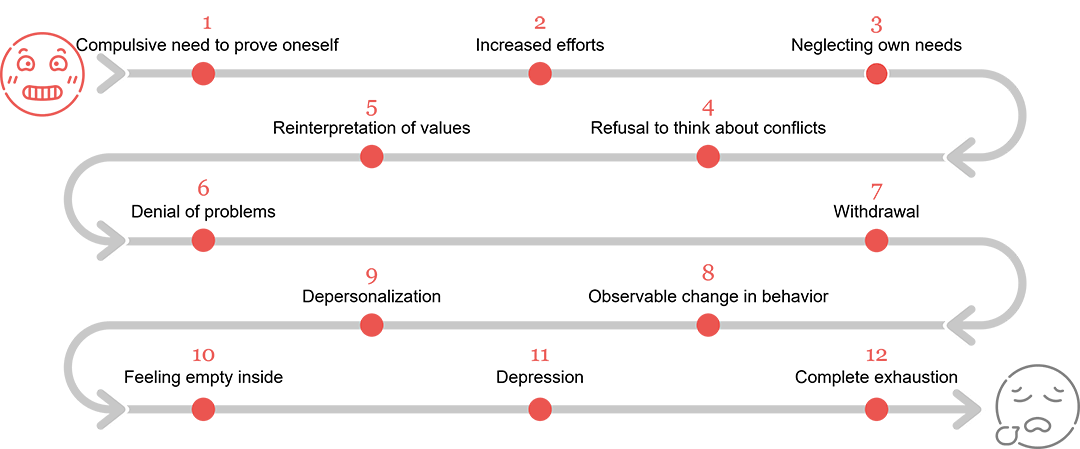
Fig.: Burnout: 12 phases according to Herbert Freudenberger
Stage 1: The compulsion to prove oneself
In this initial phase, people often try to prove their abilities to themselves and others, which leads to placing excessive demands on themselves.
Stage 2: Increased effort
In order to meet their own expectations, those affected increase their efforts, resulting in a heavier workload.
Stage 3: Neglect of one’s own needs
In this phase, those affected begin to neglect their own needs, such as breaks, nutrition and social contact.
Stage 4: Suppression of conflicts
Conflicts arising from the excessive workload are ignored or suppressed rather than resolved.
Stage 5: Reinterpretation of values
Personal values and priorities change, often shifting towards an increased focus on work and success.
Stage 6: Denial of the problems
The existence of problems is denied, which prevents a constructive engagement with the situation.
Stage 7: Withdrawal
Those affected increasingly withdraw, both professionally and privately, and avoid social interactions.
Stage 8: The compulsion to prove oneself
This compulsion to prove oneself recurs, but with increased intensity, which further exacerbates the situation.
Stage 9: Depersonalisation
A sense of alienation from oneself and others sets in, often accompanied by emotional coldness and a loss of empathy.
Stage 10: Inner emptiness
Those affected feel empty and burnt out inside, lacking energy or motivation.
Stage 11: Depression
This can lead to severe depression, characterised by hopelessness and exhaustion.
Stage 12: Complete Exhaustion
In the final stage, complete physical and emotional exhaustion sets in, often accompanied by serious health problems.
Approach
Resilience training
Held every two days, for managers, staff or as a team
Also available as a module within development programmes, with optional coaching to support implementation within your own team
Training on resilience and mental health for staff
2-day course, for managers
Key insights on resilience and mental health
3-hour online workshops for managers
Resilience workshops for teams
2-day programme, for teams – building team resilience and psychological safety within the team
Resilience coaching
Resilience coaching based on the PSI test, with reflection on personal motivations and self-management skills
‘Protective shield’ services with psychotherapists from our team
Therapy sessions offered by the company for staff and managers, which they can attend anonymously