Growth Leadership – Leadership with a focus on development
- How is the development of individual employees promoted and supported within our company?
- Who are the mentors for those wishing to develop further?
- Do we have a comprehensive overview of high-potential employees, top performers or high potentials?
- How do we measure performance – and how do our leaders challenge and support people who want to contribute beyond the boundaries of their own role?
It is the managers’ role to work together with employees to deliver the best possible performance and achieve the objectives. It is also their role to retain employees within the company and support them in their development. When these two aspects go hand in hand, managers initiate a self-reinforcing cycle of development in performance and impact, skills and understanding of roles – including their own. This is how we succeed in advancing both people and the organisation simultaneously. To achieve this, we need, on the one hand, an understanding of the cycle and the specific phase in which different employees currently find themselves, as well as the ability to set leadership priorities tailored to employees’ respective needs in the various phases.
A company’s value develops largely through the growth of its members – through their interest in their own tasks, their willingness to learn, their readiness to develop, and the translation of this into customer value. Every single individual possesses the potential to drive the company forward and build on shared success.
Companies that succeed in establishing an open culture of learning and development (the ‘Learning Zone’, with space for experimentation, learning and training) alongside the necessary performance culture (the ‘Performance Zone’) are better able to harness this potential to enhance performance than others. Work environments in which people who challenge the status quo and show exceptional commitment are seen as the exception – or even as disruptive – risk losing precisely those high-potential individuals.
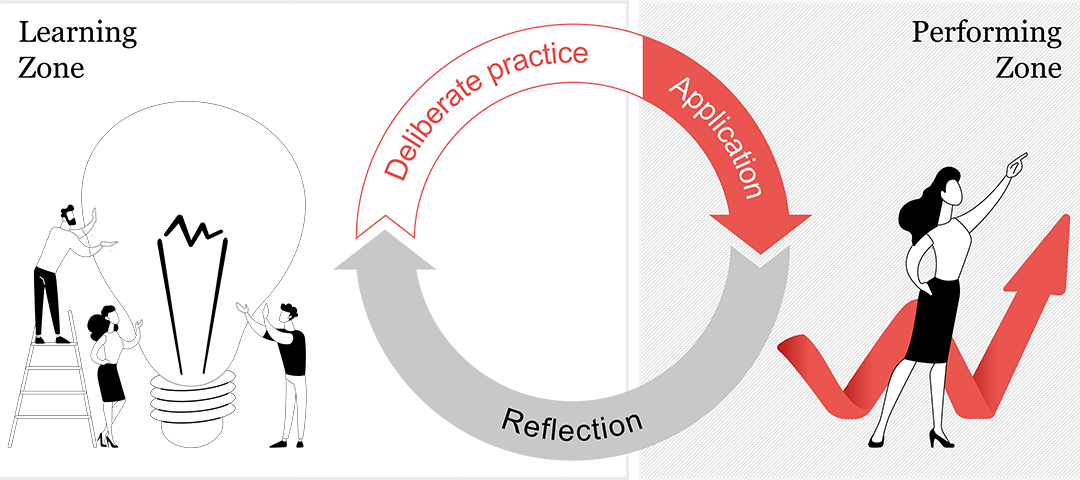
Fig.: Learning and Performing Zones (based on Eduardo Brinceno)
5P Growth Leadership Model – Leading as a development partner
The 5P Growth Leadership Model helps leaders to keep the focus on employees’ progress and growth.
Taking a conscious look at one’s own development cycle within one’s role and at the journey of individual employees helps leaders adopt a proactive approach to the various phases of employee development and leadership:
Only in this way can leaders succeed in acting in a way that fosters growth, in line with individual needs, in their day-to-day leadership roles. The 5P Growth Leadership Model views leadership as a development partnership – a shared journey in which leaders provide differentiated support at each stage, with the aim of enabling every individual to grow and develop. Performance appraisal and development can thus be systematised, becoming a transparent process for both managers and employees that serves as a basis for dialogue and mutual feedback.
The focus is on the development of employees in terms of performance, contribution, competence and role. The ‘Journey of the Development Partnership’ provides an overview across defined phases, thereby enabling leadership that is consciously tailored to needs, so as to facilitate individual development whilst acting as a mentor on behalf of the organisation.
Growth Leadership – The journey through five phases of employee development within a role.
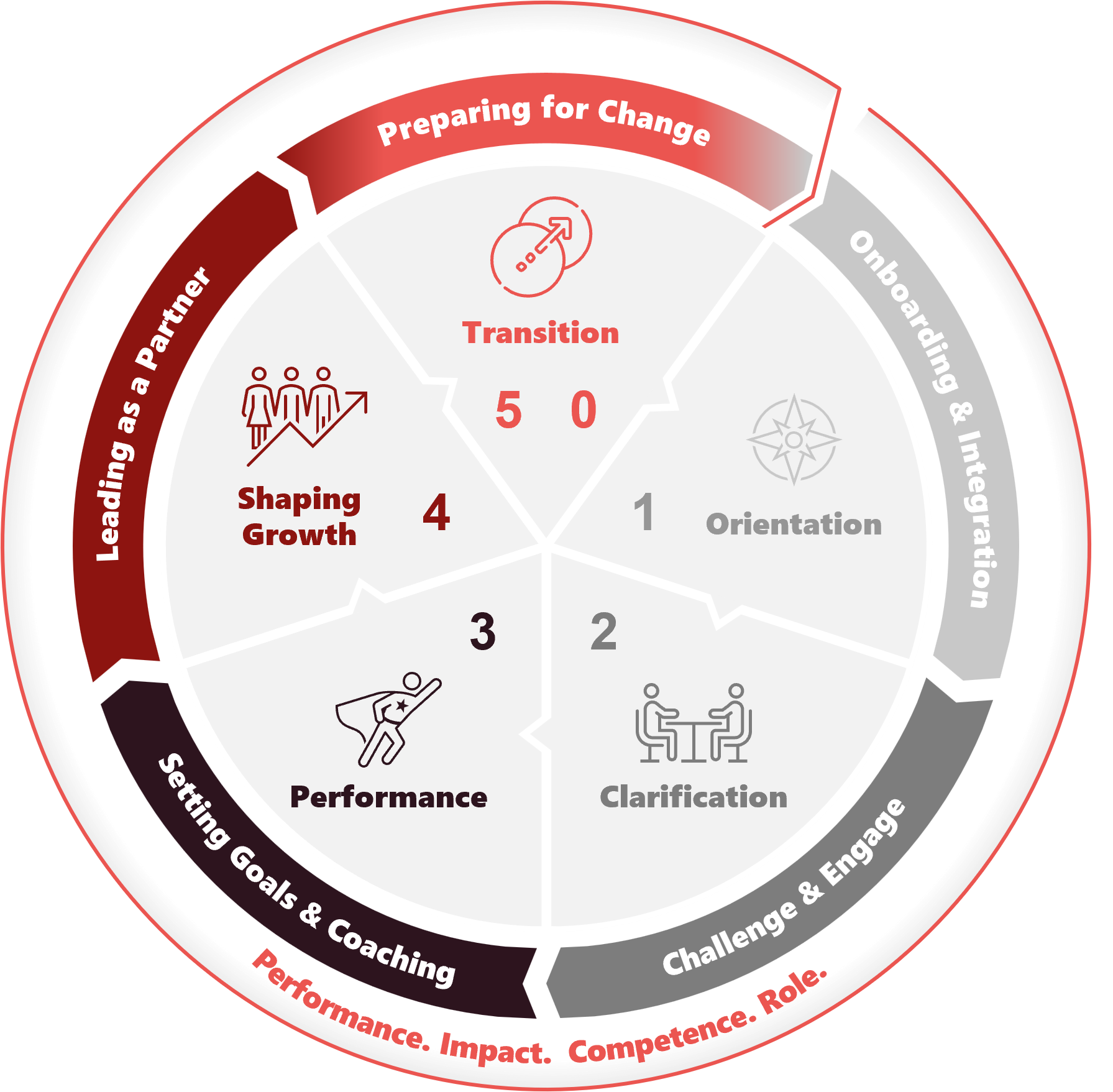
Fig.: Growth Leadership
Development partnership in leadership:
1. Orientation
New staff members tend to tread carefully in their new environment, at least until they have a clear understanding of their exact role and responsibilities. They rely heavily on information to better understand how things work and how they can best contribute. The main responsibility of management here is to integrate staff members both socially and professionally, and to enable them to become operational and work independently as quickly as possible. The induction phase can also apply to the manager themselves, for example, if they are promoted to a new level or are taking up a new management role within the company.
2. Clarification
Provided the first phase has been successfully completed, new employees have gained confidence and are more familiar with their working environment, so that their initial reserve gradually gives way and they contribute their views more actively. Implicit norms of collaboration, which have developed within a team over time, are more frequently breached, as they are either ignored or challenged by new employees. It is now up to the manager to use differences of opinion and conflicts as an opportunity for development. In this phase, the aim for both sides is to recognise the current level of competence and performance, to understand mutual expectations, and to clarify these for the future.
3. Performance
This phase begins once a shared understanding of performance expectations and collaboration has been established – and there are no outstanding or latent conflicts regarding these matters. Sufficient openness has developed to address issues without them escalating into conflicts. This new quality of collaboration now allows for an increasing focus on self-directed performance. The manager’s role is to support employees during this phase through joint goal-setting and coaching. Reaching this phase with each employee – varying according to context and task – at an appropriate time should be a clear objective.
4. Shaping growth together
In the transition to the fourth phase, employees demonstrate that they not only perform their tasks well, but also have the competence and willingness to go beyond their remit to commit to the company. This phase may, but need not, be reached by all employees. It is usually those who have a particular interest in the bigger picture – and in development: both their own and that of the company. Enabling this and driving it forward together shapes the leadership style in this phase. The leadership responsibility here lies largely in channelling employees’ interest into the company – and therefore involving them in decision-making and leadership tasks.
5. Transition
Employees leave a position, a team or even the company to pursue further development elsewhere. This phase can follow on from any of the previous ones . In this phase, preparations are made for the transition, both in terms of succession (recruitment) and knowledge management, and, where necessary, separation management. When new staff members join, the cycle begins anew, once again with phases that vary in intensity from person to person.
Application
Training for managers:
In training sessions, managers can benefit from an intensive exchange of different experiences and perspectives.
- In addition to a basic introduction to the model and the various phases and requirements, participants first reflect on their own personal experiences in the role of an employee, so that they can then, building on their own experiences, categorise the employees they manage and define their requirements in a manner appropriate to the phase.
Appropriate exercises and methods for conducting conversations suited to each phase help managers to optimise their development partnership with their staff.
Reflection tool in coaching:
In coaching, the model provides a valuable basis for reflecting on one’s own team and supporting team members appropriately in line with their respective development phases.
Workshops for the leadership team:
The ‘Growth Leadership – Leadership as a Development Partner’ concept can be utilised in leadership team workshops to establish a shared perspective and to systematically categorise and discuss employees and their development potential within the organisational context.