Leadership Principles for sustainable business success
- What principles do we follow in leading our organisation?
- Do our company’s established leadership principles reflect our culture?
- How would one most readily recognise a top leader in our organisation?
Good leadership – shaped and defined collectively – is the cornerstone of successful organisations. A roadmap is needed to provide guidance and support in difficult situations or for young, new leaders. Leadership principles are only as good as the way they are lived out and perceived. If there is a lack of understanding, they remain ineffective; if they contradict the culture that has been practised to date, it takes a great deal of effort and perseverance to implement them.
Leadership is increasingly shared amongst several people – whether in lateral leadership situations, in agile organisations, or in changing project teams. On the one hand, this requires everyone to be flexible enough to take on different roles and assume responsibility, regardless of their function; and at the same time, it demands a shared understanding of what constitutes leadership.
It has always been true that good leadership generates momentum rather than pressure: until recently, one could get by quite well with the latter. However, the current labour market situation shows that, in order to attract the best talent, retain them in the long term and help them realise their potential, what is needed is inspiration, cooperation, opportunities for development, as well as scope for self-fulfillment and a healthy work-life balance. Alongside the pressure to deliver results and the major challenges facing the business environment as a whole, it is becoming increasingly demanding for leaders to confidently meet this wide range of expectations.
Genuine leadership principles and a shared, empowering leadership culture provide a framework that offers guidance and stability during protracted crises, enabling leaders to act constructively and in a manner appropriate to the context. Clear leadership principles, which can be understood, internalised and authentically upheld by all leaders, form the foundation upon which a new spirit of collaboration can flourish and grow across all levels of the organisation.
Authentic leadership behaviour delivers results and makes an impact
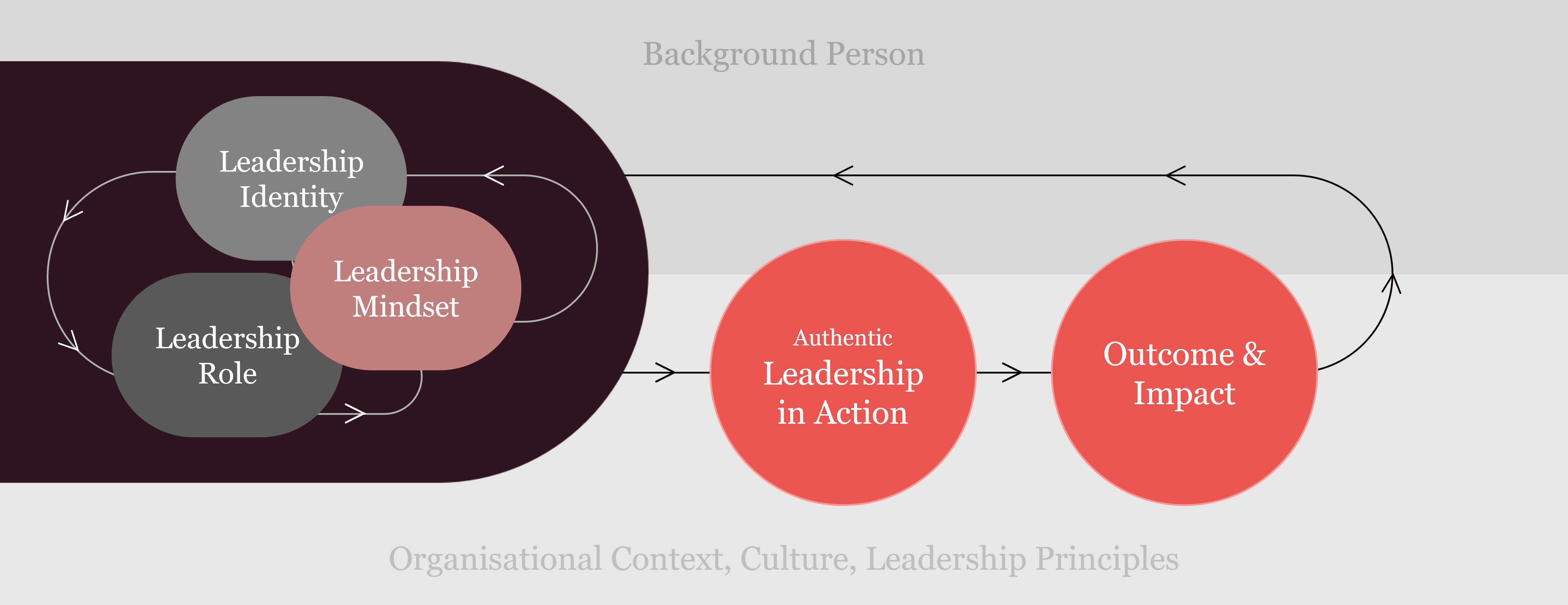
Fig.: Authentic leadership
An individual’s leadership identity is strongly shaped by their personal background, such as their origins, the environment in which they were raised, their education and role expectations. This gives rise to a sustainable leadership approach which, through personal development and growing experience (gained from day-to-day leadership, training, coaching, sparring, etc.), can evolve into authentic leadership behaviour.
The more credibly a person can champion their goals and decisions in day-to-day leadership, exemplify their expectations of others and act reliably within the organisational context, the more powerful their impact on results and effectiveness will be.
Our expertise to support your approach
One possible approach to establishing leadership principles:
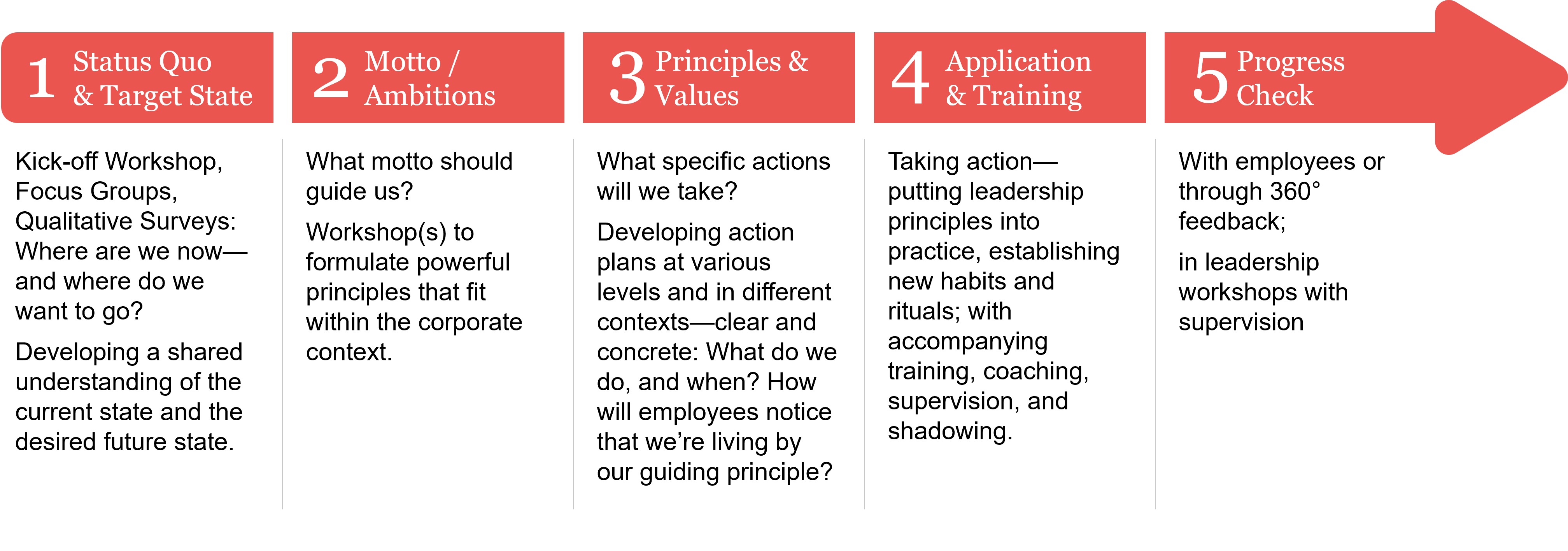
Fig.: 5P Approach to Establishing Leadership Principles
Since our foundation, we have partnered with organisations to develop tailored leadership principles and competency frameworks that reflect their unique culture, strategy, and ambitions.
This is because the development process is a collaborative one that takes into account the organisational context and the current level of maturity of the leadership team, as well as the shared vision. Key questions guiding the development process include:
- Where or to what end are we guiding our staff – and what do they need to get there successfully?
- What leadership style do we want to foster to bring our shared vision to life?
- Which personalities drive our company forward, and who are the key individuals we wish to retain?
- How do we support the development and performance of individual employees or teams?
- How do we deal with typical leadership challenges?
- How do we make and communicate decisions?
- How do we set or achieve goals?
- How do we resolve conflicts within the management team and in our teams?
- What kind of learning culture do we need to drive performance while fostering innovation and creativity?
- How do we communicate on a day-to-day basis and in line with our strategy?
- How do new employees experience and recognise our leadership culture?
- Which leadership behaviours are clear no-gos for us?
The journey is just as important as the destination. The more vibrantly and honestly leadership principles are discussed and developed, the more likely it is that a coherent leadership culture will develop on this basis of trust. This requires honest monitoring and established habits or rituals that serve as a compass for individual leaders and are evident in day-to-day life. For many leaders, this process yields new insights and also new demands that require personal development and new leadership skills. The process must not end here; rather, binding development goals and measures must be agreed upon. Regular reflection cycles throughout the year, which focus on the topic of leadership, are also essential for effectiveness.
1. Current Situation & Target State
In this first step, the current state of the organisation or the (leadership) team is analysed A shared understanding of the organisation’s current state is essential: where it stands today, where its strengths and development areas lie, and which challenges it needs to address. Building on this foundation, a clear vision is defined for the desired future state. The clearer and more inspiring it is, the greater its impact on the change process.
2. Motto & Ambitions
Once the target vision has been defined, it is important to formulate a motto or set out several ambitions that summarise the vision and the objectives of the change. The motto serves as a guiding star and a motivating force that steers the team through the change process. It should be inspiring, yet concise and catchy, in order to generate enthusiasm and commitment amongst as many people as possible.
3. Principles & Values
In this step, specific guidelines are developed to set out the principles and values that managers and staff should adhere to. These guidelines serve as a framework and guide for day-to-day actions and decision-making. They should be clear and actionable and align with the organisation’s overarching objectives.
4. Implementation & Training
The guidelines and principles must now be put into practice. This is achieved through targeted implementation and training programs that help managers and staff integrate the new way of working together into their day-to-day work. Training courses, workshops and coachings are key elements in ensuring that managers and staff acquire the necessary skills and knowledge to successfully implement the new ‘We’.
5. Progress Review
The progress of the implementation is reviewed and assessed through regular reflection cycles. It is important to regularly reflect on whether the defined objectives have been achieved, what challenges have arisen and what adjustments are necessary. Reflection within the leadership team enables continuous learning and improves the process of establishing leadership principles. Feedback loops and evaluation methods are essential in this regard.