Assessment & Development Center
- We’re filling an important position—how do we determine who has what it takes?
- Who do we want to invest in specifically—who has the potential for future key roles?
- Who do we accept into our talent program—and how do we make this decision in a sound and transparent way?
- How do we determine where our leaders or employees stand today and what they need for their next step in development?
- How do we design an Assessment or Development Center that truly aligns with our re-quirements, our culture, and our participants?
1. Assessment Center (AC)
HR decisions set the course for a company’s success. The key factor is finding the right fit, i.e. en-suring that a person possesses the relevant personal, social as well as business, leadership and management competencies to be effective in a specific role. Poor hiring decisions, on the other hand, often lead to additional costs and time expenditures, lost productivity, and declining mo-tivation—and can also negatively impact a company’s attractiveness as an employer.
Assessment centers are among the most effective methods for making well-informed selection decisions. They make it possible to observe relevant behavior in specific, success-critical situa-tions and enable competencies and potential to be systematically assessed in relation to the re-quirements of a position. This creates a solid foundation for evaluating the fit between the indi-vidual and their future role.
2. Development Centers (DC)
The methods used in DCs and ACs can be nearly identical. The key difference lies in their objec-tives and process logic. DCs are development tools; they make development tangible and expe-riential. Participants find themselves in challenging situations, discover their own strengths and development areas, receive feedback, and can immediately try out new approaches. This also helps participants clarify their own development goals: What do I want to work on? What do I want to keep or change? What do I want to try next? This results in more than just an assessment of current level: The DC becomes an intensive space for learning and reflection. And not just for the participants—observers also sharpen their perspective on leadership, competencies, and de-velopment within their own organization.
3. Hybrid: Identifying and Developing Talent
Talent decisions are often both selection and development decisions. They set the course for who will take on more responsibility in the future and help shape the organization. What mat-ters here is what people have already demonstrated—performance, commitment, and past de-velopment—as well as the question of what potential they still have and how well they can de-velop it.
Talent processes therefore often combine elements of assessment and development centers: they reveal potential in relation to specific future requirements and create a solid foundation for identifying talent and making development decisions. In this way, they support the selection process for talent and leadership programs, the design of career paths, and talent and succes-sion management—while also highlighting areas where development can begin. Transparent decisions, constructive feedback and development opportunities are crucial for all involved, es-pecially when not everyone can be accepted into a programme.
Systemic Action Diagnostics
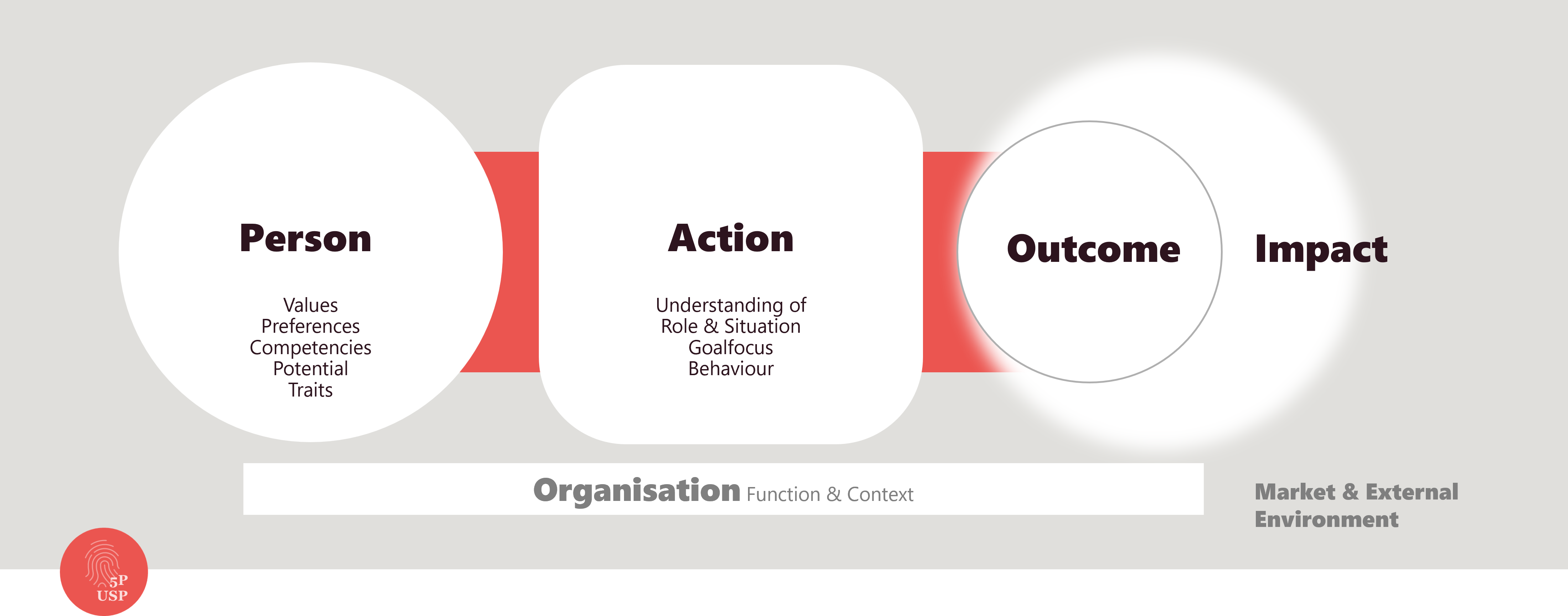
Our approach combines behavioral assessment with a systemic perspective. In realistic situa-tions, it becomes clear how people handle specific challenges, which competencies they use and the impact they achieve. At the same time, we examine the context in which this behavior arises: What demands does the role place on them? How do they interpret the situation? What organi-zational conditions are at play? In this way, we gain not only a sound assessment of competen-cies and potential but also concrete starting points for what people and the organization need for successful development.
Success Factors in Design and Implementation
Precisely defining goals, impact, and requirements
We begin by asking which decisions or developments the AC/DC supports, and which processes it should be compatible with. To this end, we identify requirements and critical incidents—situations critical to success in the respective role—and link them to existing competency mod-els, job or role descriptions, and relevant existing data, such as from employee surveys or 360° feedback. If needed, our 5P competency model serves as a scientifically grounded reference framework to refine requirements, identify gaps, or collaboratively develop a suitable compe-tency profile. This creates a clear foundation for what should be observed—and why.
Designing the Entire Process
The quality of an AC/DC goes far beyond its execution: How participants understand and expe-rience the process influences what can be revealed. That is why professional process design also encompasses communication, clarifying expectations, providing feedback, and handling the re-sults. For external applicants, this is part of the candidate experience and employer brand. For internal participants, transparency, fairness, and a professional approach to the results are essen-tial prerequisites for acceptance of and trust in the process. This creates a transparent and re-spectful framework that generates personal value regardless of the outcome.
Diagnostically Translating Success-Critical Situations
How well the success-critical situations of a role are represented in the AC/DC significantly de-termines the quality of the entire process. The more precisely they reflect the actual challenges of a role, the more relevant the observations are, the easier it is for participants to relate them to their own reality, and the higher the level of acceptance. At the same time, they establish a con-nection to actual day-to-day work—and thus create an important prerequisite for subsequently applying insights in practice. That is why we develop tasks and settings that are as close as pos-sible to organizational reality. Ideally, we develop the setup through co-creation to ensure that it accurately reflects the company’s specific characteristics in both detail and wording.
Targeted Combination of Internal and External Expertise
Different perspectives make assessment more meaningful. Internal observers contribute their knowledge of the organization, culture, and practical requirements; we supplement this with di-agnostic expertise, methodological rigor, and an independent outside perspective. Role-play partners provide their own impact-oriented perspective through direct interaction with partici-pants. We systematically integrate these perspectives.
We specifically prepare internal observers and role partners for their tasks - covering require-ments and competencies as well as observation, observer biases and rating errors - and estab-lish clear principles for evaluation and the observers’ conference.
Participant Briefing: Ensuring Clarity and Confidence
Those who know what to expect can focus their attention on what matters most. That’s why we ensure clarity regarding the goal, process, roles, framework, and how to handle results even be-fore the AC/DC begins.
A professional briefing provides guidance, clarifies open questions, and reduces uncertainty that has nothing to do with the requirements being observed. For virtual and hybrid formats, we also consistently incorporate technology and digital collaboration.
Digital or In-Person Delivery
For target groups that also collaborate digitally in their day-to-day work, virtual or hybrid AC/DCs can offer distinct advantages from both an organizational and diagnostic perspective. Travel costs are reduced, while at the same time, senior leaders and executives as authentic stakeholders or various sparring partners can be easily integrated into individual sequences. The more reserved presence of observers can also support interaction.
Virtual and in-person formats open up different observation opportunities: While digital for-mats primarily reveal authentic behavior in virtual collaboration, in-person sessions offer more direct access to interaction, dynamics, and nonverbal behavior. We consciously take this into ac-count when selecting and designing the format. In this way, we utilize digital possibilities where they create genuine added value, both diagnostically and organizationally.
Strengths-Based Approach and Feedback
A certain amount of tension is inevitable during an assessment. The more open and trusting the atmosphere is, the better competencies and potential can be assessed. This requires a strengths-based, development-oriented approach rather than a critical testing culture. This does not mean “downplaying” differences or development areas. On the contrary: a trusting environment ena-bles clear observations. We deliberately integrate feedback and reflection into the process—particularly in the Development Center, where we also use adaptive elements and opportunities to immediately try out new approaches.
Consolidating observations into a robust overall picture
The second, often equally important part of an assessment center is the observers’ meeting, dur-ing which observations and impressions are shared, competencies are evaluated, decisions are made, and recommendations for development and leadership are formulated. Here, we not only summarize the individual results but also develop a shared understanding based on all impres-sions and perspectives.
Clear Findings and High Immediate Value
We consolidate the results into a report that is fully transparent to participants and clearly brings together strengths, development areas, and relevant observations.
Decisions regarding the hiring decision or, for example, participation in a talent program are communicated internally by HR or the direct supervisor. In addition, participants are invited to a feedback and development meeting based on the report.
Consistently leveraging insights
Every AC or DC provides a wealth of insights—for participants preparing for a new role based on the results, and for everyone else as a source of personal development planning and feed-back for their current responsibilities. For all internal participants, the goal is to translate the in-sights gained into concrete development—regardless of the outcome of any related selection decision.
Beyond individual results, ACs and DCs also provide a valuable data set for further organiza-tional analyses. If desired, we can evaluate the results anonymously and across participants: What patterns emerge? Which strengths and development areas recur? And what insights does this provide, for example, regarding role design, recruiting, talent processes, diversity, or leader-ship?
Wide Range of Applications
As versatile tools, ACs and DCs can be used in talent and succession management, leadership development, recruiting, internal hiring, and change management, among other areas:
- High-quality hiring decisions for external candidates
- Transparent, accountable internal hiring, even in times of change
- Well-informed career decisions and nominations for development programs
- An overview for the company of available leadership talent within the organization
- Timely assurance of internal succession planning for leadership positions
- Individual performance assessments and development planning
- Targeted, individualized leadership development
- Identification of high-potential individuals for agile leadership roles, project management, ex-pert roles, or leadership careers