Potential Analysis and Reflection Tools for Individuals and Teams
- Which tools support development, reflection and better recruitment decisions?
- What are useful decision-making criteria for selecting tools?
- Which tools are perceived by participants as meaningful and helpful?
- What is important when using these tools to ensure they are effective and accepted?
The market offers a wealth of potential analysis and reflection tools. Some promise a very wide range of applications, whilst others are tailored to specific use cases.
At 5P, we have been successfully using various tools for more than 20 years and are not tied to any one of them. We select the tool that best suits your needs.
For each of the tools we use, we have certified consultants on our team. This means you have access to in-depth expertise and direct points of contact.
For us, it is not just about the tool itself, but about its seamless integration into selection or development processes. When used correctly, these tools achieve their full impact through transparent communication, careful evaluation and joint reflection.
What is the focus of a tool and for which purpose is it suitable?
The following matrix categorises our core tools according to these two axes. Their content focus and the context (selection, development, evaluation). This illustrates what a tool can achieve and whether it is suitable for the question at hand.
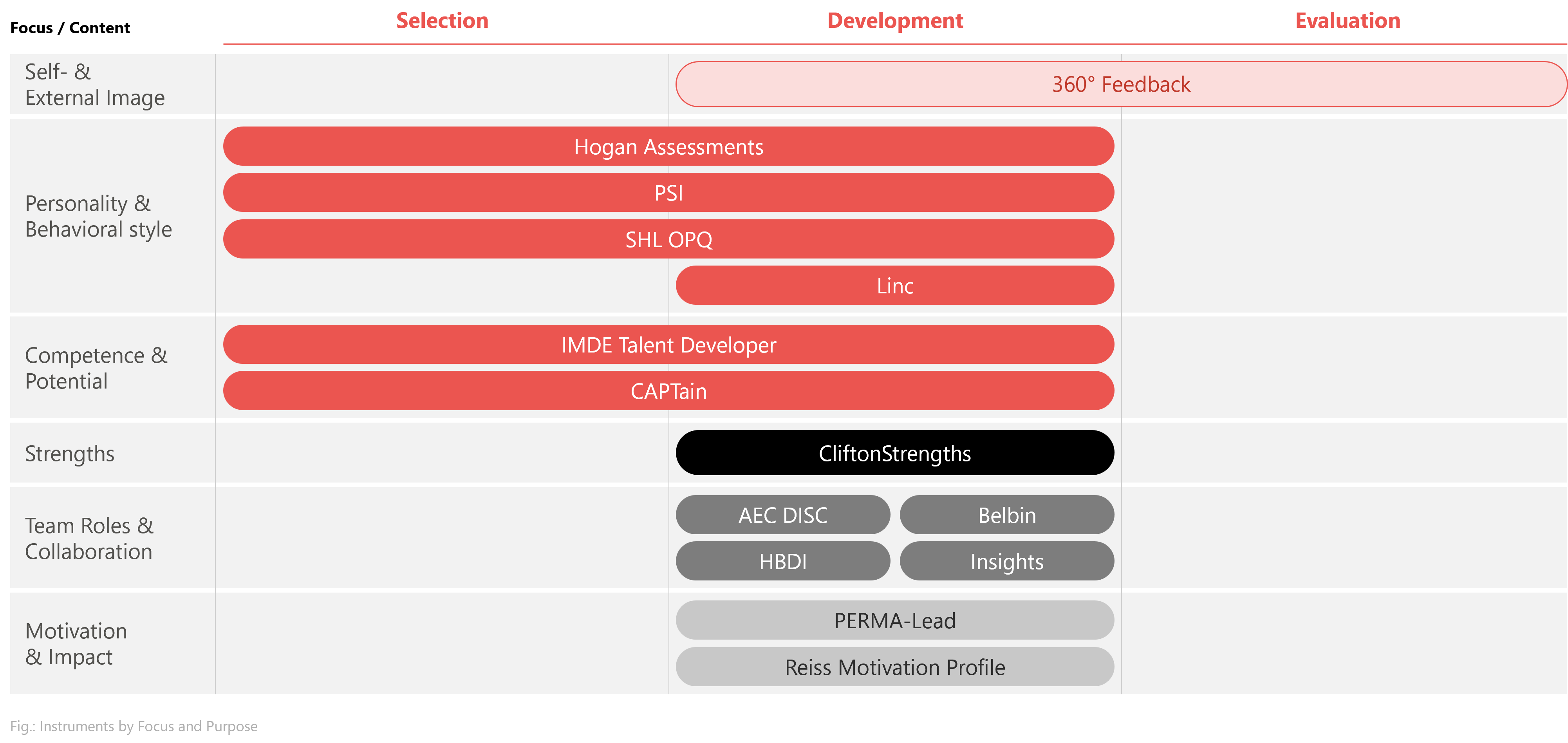
Tools that can provide insights relevant to selection or evaluation compare responses with standard or benchmark groups. The other tools, such as CliftonStrenghts, Belbin, AEC-Disc or HBDI, are also designed to compare responses with a standard group. However, they deliberately do not assign a rating . This is precisely what makes them so effective when used in workshops and training sessions.
Two tools – explained by way of example
We will use two methods from our toolkit as examples. Both can be calibrated to our competency model and demonstrate just how varied diagnostic approaches can be.
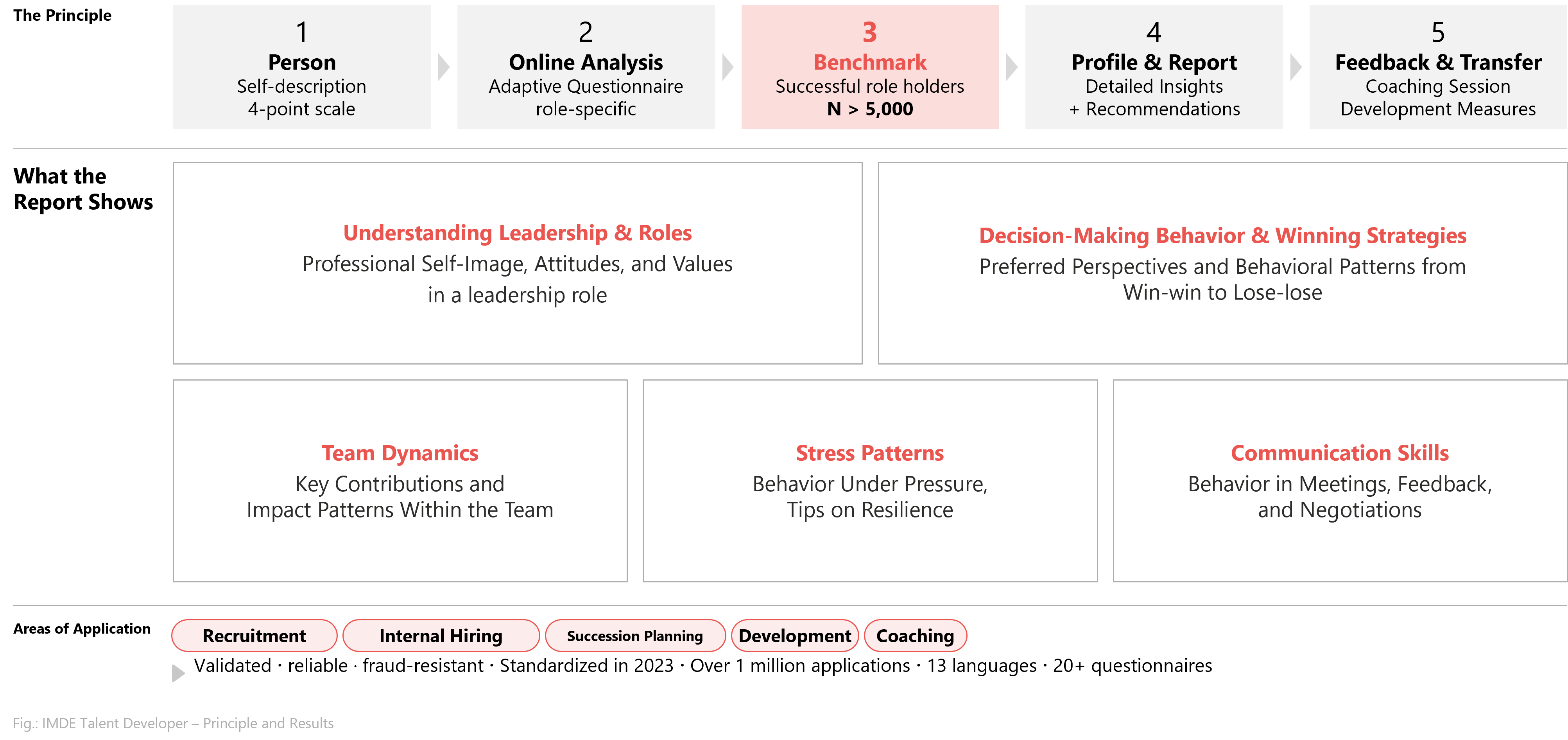
IMDE Talent Developer.
An in-depth, role-specific potential analysis that compares role understanding and competencies with those of successful benchmark groups and derives concrete development recommendations from this.
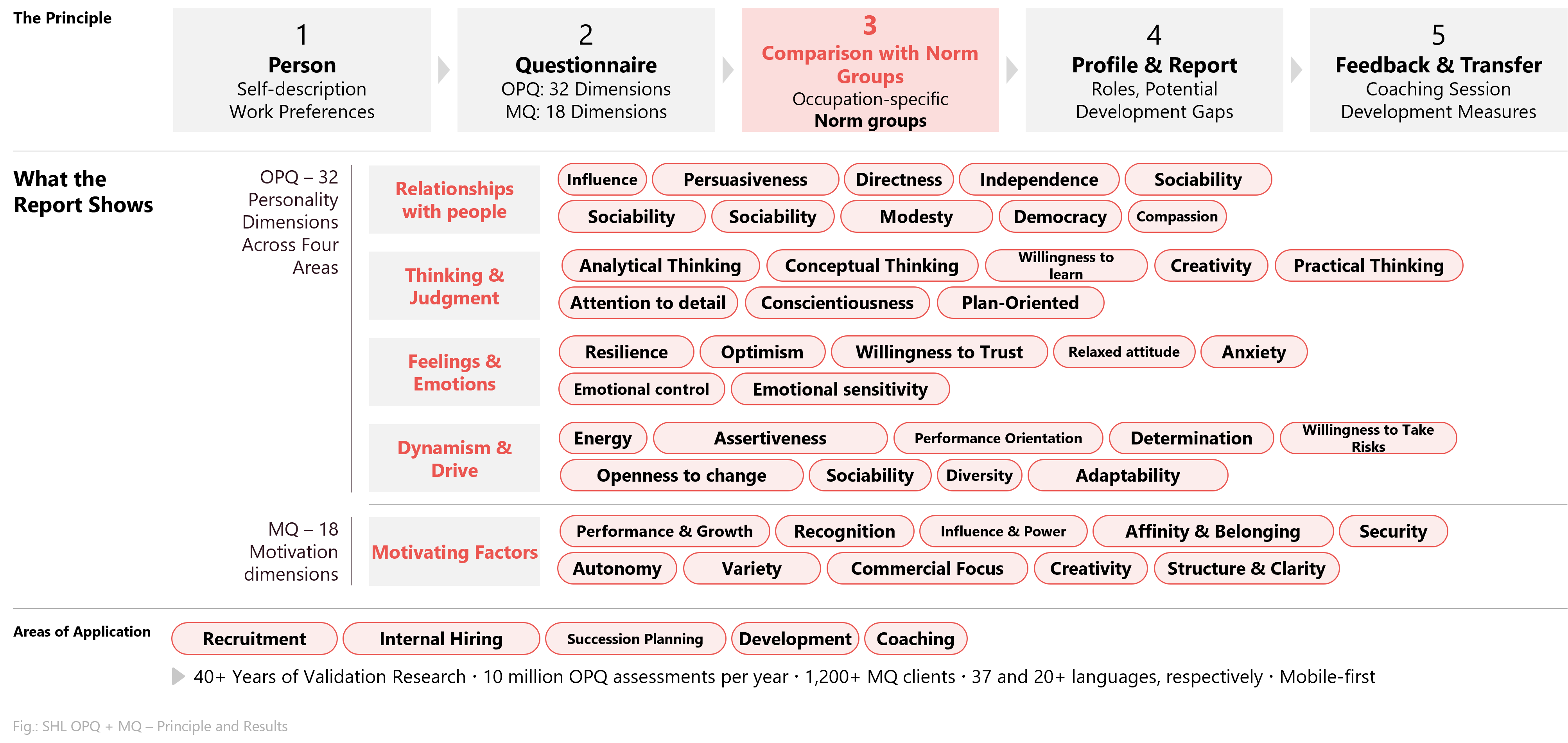
SHL OPQ & MQ
Two complementary tools: The OPQ measures 32 personality dimensions directly related to professional behaviour and effectiveness, benchmarked against occupation-specific norm groups. The MQ complements the personality dimension with 18 motivational dimensions and reveals what truly drives people at work.
Procedure
Through our integrated competence and diagnostic model, we can link questionnaire tools with 360° feedback and assessment elements. This allows results from different methods to be compared and effectively combined.
The full impact is achieved through careful integration, transparent communication and joint reflection on the results.
From your question to putting it into practice in six steps:
1. Clarify objectives and requirements.
We define the requirements critical to success and, where necessary, tailor the tools to your skills profile.
2. Align on the process and feedback.
We agree on how results will be evaluated and shared, as well as how information will be provided and communication managed throughout the process.
3. Online questionnaire & report.
The participants complete the questionnaire – the report is generated automatically.
4. Feedback or coaching session.
We provide feedback and work together to refine the development goals.
5. Team reflection.
The results are contextualised within the team – to ensure a shared understanding and coordinated development.
6. Implementation both at work and outside work.
Specific steps in day-to-day work and beyond to achieve the objectives.