Individual Leadership Programmes & Learning Journeys with Impact
- What characterises leadership in our organisation?
- What unites our leaders in terms of their attitude and approach?
- To what extent do our leaders live up to what our employer branding promises in their day-to-day work?
Effective leadership begins with oneself.
A well-structured leadership program provides leaders with the space for an honest self-assessment: it sparks curiosity and a genuine interest in their personal strengths, potential and areas for development – and, not least, in their own blind spots. This inner clarity is the cornerstone of effective self-management and credible, sustainable leadership, even under challenging conditions.
From purpose to impact
Starting from their own leadership purpose – ‘Why am I in this role, and what is the deeper meaning of my leadership work?’ – participants refine their sphere of influence. Regular reflection on one’s own ‘Circle of Influence’ provides guidance: tasks, role requirements and leadership tools are specifically tailored to ensure they are suited both to the organisation and to the individual’s own personality.
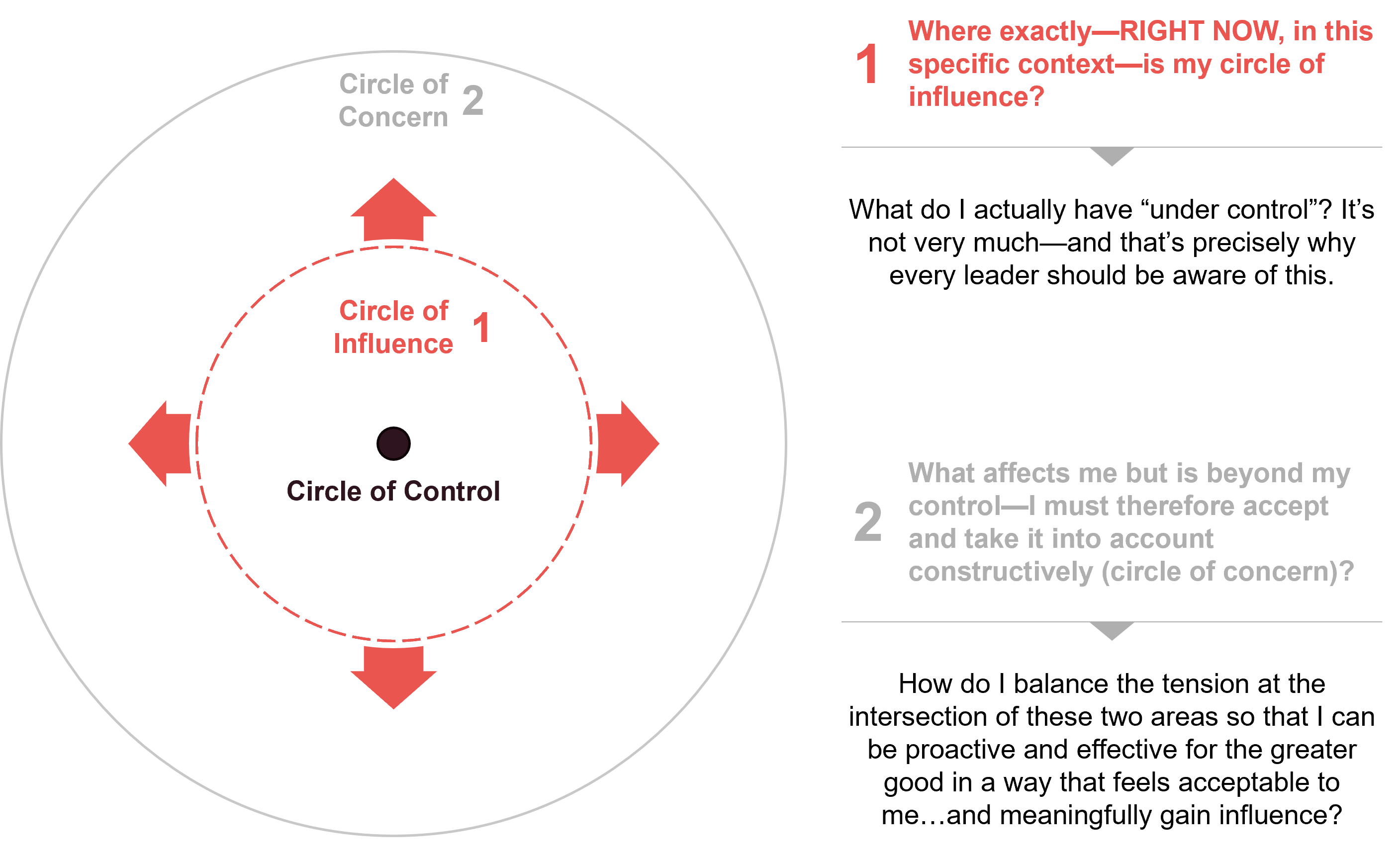
Fig.: Circle of Influence
Successful implementation
Any program is only as good as its lasting impact on participants’ day-to-day lives and their working environment. In the training sessions, we therefore work with specific cases and current challenges drawn from participants’ everyday working lives, with a strong focus on practical application. Participants define how they will apply their learning in their own leadership context and reflect on their progress, insights, and successes in subsequent modules. The greatest impact is achieved when learning extends beyond the training sessions themselves: before, between, and after each module, participants, their line managers, and HR work together to reinforce the program and embed new leadership behaviours in everyday practice.
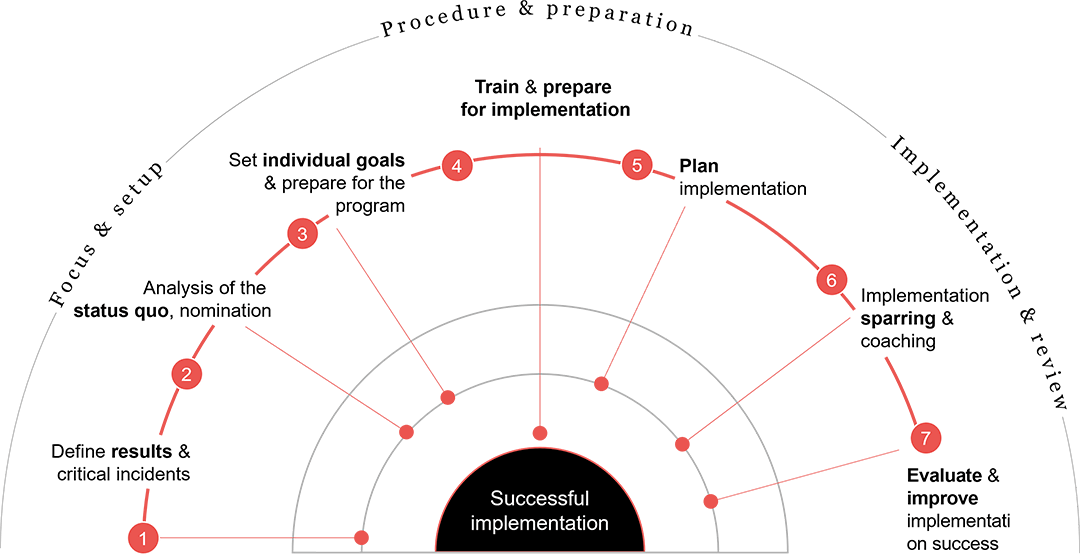
The 7 steps of a highly actionable design
1. Define outcomes & critical incidents
The organisation’s leadership DNA as the foundation: your organisational goals, your leadership brand, your leadership principles, existing leadership competencies and tools form the basis and starting point for designing your leadership program. But also the aspirations regarding how your leaders should act to guide their staff towards the future. Where requirements have changed, we recommend joint further development through co-creation. – Building on this, we work with you to develop a coherent strategy with long-term development goals for your leaders.
2. Assessment, Nomination
By assessing the current situation against success-critical competencies and real leadership challenges, we help participants reflect on their understanding of their role and make underlying assumptions visible, tangible, and open for discussion. The result provides an overview of strengths and areas for development for all participants individually, as well as a summary of the respective group of participants or, in cyclically recurring rounds, of the leadership landscape within the organisation. Current leadership standards in practice (and as experienced by staff) are brought to light. The individual profile identifies clear strengths, potential and areas for development, which can then be addressed by each participant through a development recommendation within the framework of the leadership program.
3. Individual goals
Based on the insights from the needs assessment and the defined leadership development objectives, we design a tailored leadership program in close collaboration with HR and, where appropriate, with input from participants. We translate these objectives into measurable outcomes and create a carefully selected blend of content and formats to ensure maximum relevance and impact. We build on existing, successful formats that have already proven their worth in your organisation, adapt them – or develop new formats together with you to achieve the best possible fit.
Participants can make use of the program offerings guided by a personalised roadmap for individual competence development in line with the ‘Leadership Brand’, taking individual personalities into account. Whether the sessions take place in-person (with or without outdoor elements), virtually or in a hybrid format, and whether shadowing or on-the-job mentoring is provided alongside individual coaching, are key aspects of the conceptual work carried out beforehand. In addition to practical solutions, the focus is also on the participants’ specific development goals.
4. Training & preparing for implementation
Leadership is achieved through communication – the training aims to utilise the group as a space for mutual reflection: presenting oneself, receiving feedback, expanding knowledge, trying out new approaches, and then utilising and integrating that feedback. In every setting, everyone is both a giver and a receiver of feedback in equal measure. Learning with and from one another is facilitated within this safe and facilitated environment.
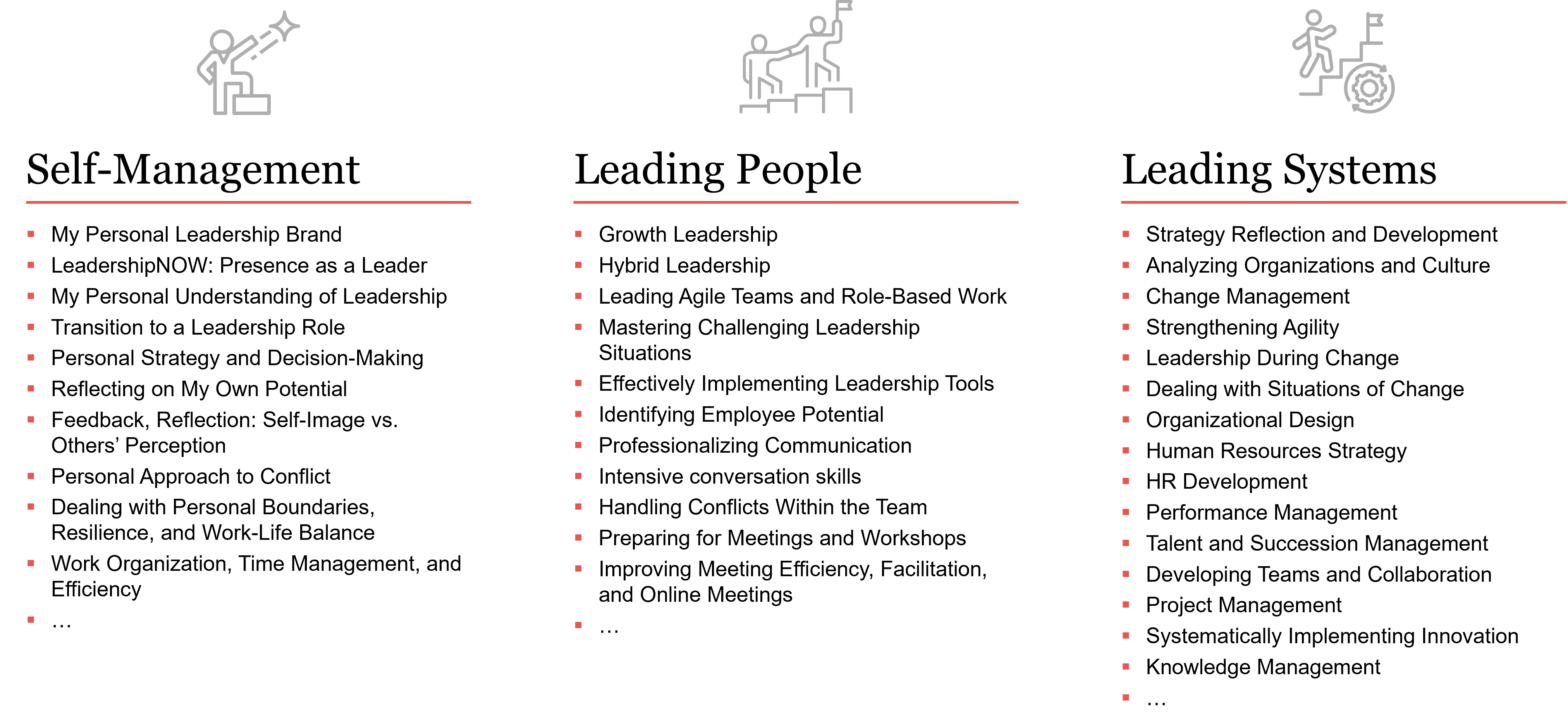
Examples of training and coaching topics from leadership programs, which can be individually adapted and combined.
5. Planning implementation
Implementation in day-to-day leadership practice is an integral part of our programs: practical projects, learning journeys, coaching, mentoring or shadowing directly in the workplace are formats that all help participants to apply new perspectives and behaviours immediately, reflect on their experiences and make their individual development visibly evident in their day-to-day work over the long term.
6. Implementation sparring & coaching
The transfer of newly acquired knowledge is all the more successful when you also have a supportive sparring partner at your side who reminds you of your ‘new self’. Particularly in a work context, managers quickly fall back into old patterns due to the power of habit. Having a coach on hand during the first few months to regularly review and refine one’s implementation goals often determines the long-term success of a development program.
7. Evaluating & Reinforcing Implementation Success
A key driver for embedding any leadership program is the evaluation and the use of the insights gained from it, both for the participants individually and for management and HR. Evaluation workshops incorporating elements of a development center, 360° interviews or the use of an employee survey supplemented by focus groups have proven effective in this regard. Ideally, this is combined with an evaluation team that also incorporates ‘hard facts’ such as target achievement rates, staff turnover figures and talent nominations into the evaluation.