Impulses
Leadership in the AI era: AI can do a lot, but leadership can do more. On direction, impact and pushing boundaries
By Sylvia Enders, Nils Landmann

The hype surrounding AI is loud – but the real test is taking place quietly in the day-to-day work of leaders and teams. Between AI euphoria and narratives of threat, a risky limbo is emerging in many organisations: high pressure to deliver, little guidance – and even disappointing results from initial projects.
There is a growing realisation that what matters is not whether the right tools are available, but whether teams use AI in a way that improves business outcomes and day-to-day collaboration, and accountability remains clear where it matters. For all the enthusiasm for AI as a technology, this is above all a question of leadership and organisation. For leaders, however, it is not about coding themselves or jumping on every bandwagon. It is about stance and the ability to shape what comes next.
Effective AI integration requires leadership – in the form of direction, prioritisation and accountability. This is precisely where our concept of AI-Augmented Leadership comes in: not ‘AI-driven’, but ‘human-led & AI-augmented’.
What we mean is a form of leadership that views AI as an opportunity and consciously shapes the mix of human judgement and AI-supported value creation: AI provides speed, options and groundwork – leadership ensures direction, results, standards, decisions and responsible collaboration.
But how, in practical terms, can AI be embedded in an organisation for lasting impact?
Many organisations launch AI initiatives from within the IT department in order to establish the foundations and build organisational capability. This is understandable – but it is not enough. The actual transformation takes place through the interplay of business, culture, people and technology. On the one hand, a top-down approach from C-level is required: forward-looking strategic decisions and a holistic rethinking of business models, core competencies and processes that ensure the company remains future-ready.
At the same time, the transformation also happens from the bottom up – driven by leaders and employees at all levels. People recognise the benefits of new technologies for their day-to-day work and adopt new ways of working. This presents both an opportunity and a risk: whilst new possibilities are unlocked, risks can also arise if tools are used without sufficient reflection or appropriate guardrails. This is precisely where leadership plays a decisive role.
Leaders need to take active responsibility for shaping the process:
- where AI improves the quality of decision-making,
- where it unleashes creativity and innovative potential,
- where it reduces administrative complexity,
- and where human judgement remains indispensable
It is not just about efficiency. It is about effectiveness. About better decisions, clearer priorities and collaboration that combines quality and speed.
To follow this path in a structured way, we have developed the 4S model – a pragmatic framework based on four stages of development.
- START Get curious, experiment and build first-hand experience
- SEED Involve the team, create room for learning, develop initial standards.
- SCALE Systematise successful applications and look beyond your own team or function
- SUSTAIN Integrate AI in such a way that it becomes a natural part of everyday work, without remaining a permanent ‘project’.
The 4S phase model
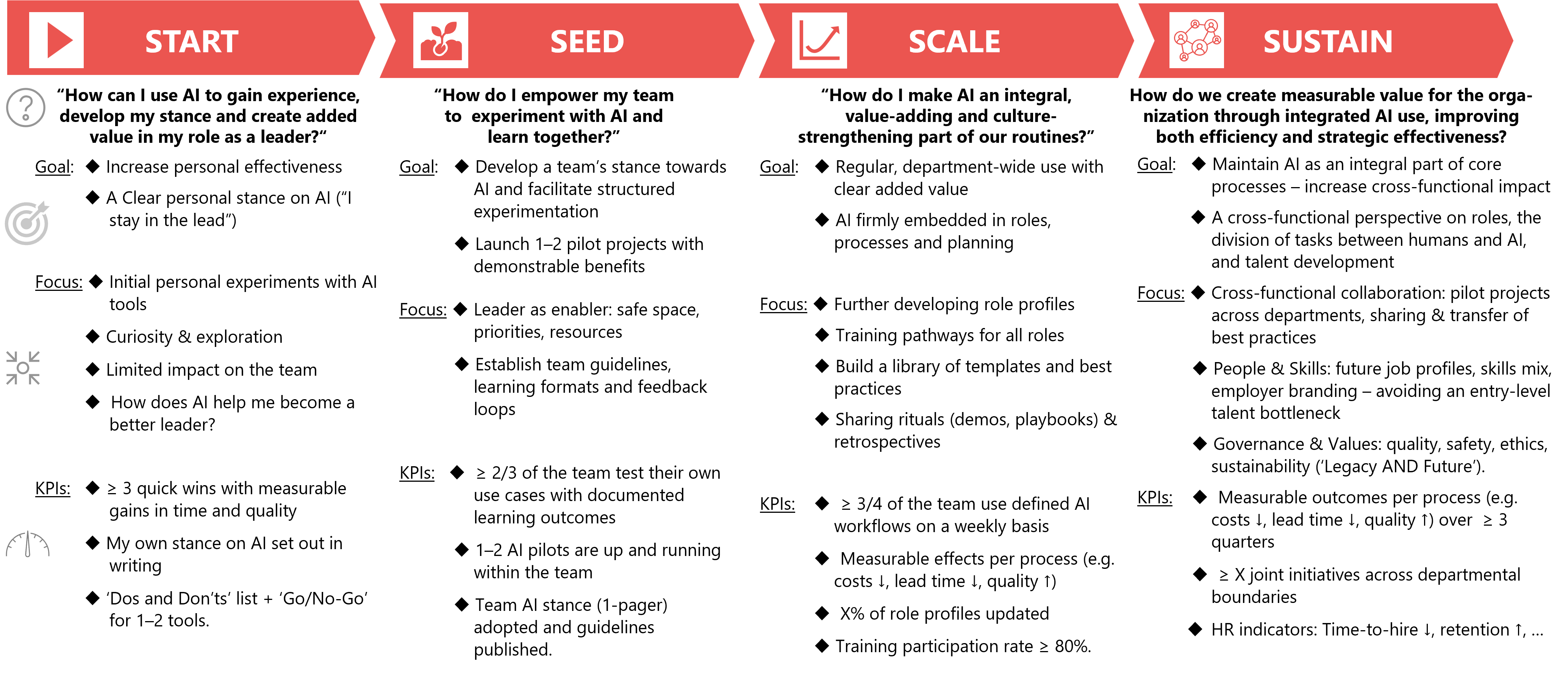
The 4S phase model provides a practical roadmap: where do leaders and teams stand in their approach to AI – and what is the next logical step? This clarifies the question ‘Where do we stand?’.
The next, crucial question, however, is: what specifically are we working on to make progress with AI integration? In other words: in which areas is AI changing leadership – and which levers can we actively shape?
To this end, we have identified ten potential areas for action. These are derived from many years of experience with transformations and have proven their worth – regardless of whether the driving force is ‘AI’ or something else. However, AI increases the pace, scope and relevance of these areas: orientation, communication, governance and adaptability come under pressure more quickly and more frequently, and that is precisely why leadership needs a clear focus. Depending on the sector, level of maturity, risk profile or culture, these areas for action can be adapted, expanded or combined. What matters is not a perfect taxonomy, but that leaders and the organisation develop a common language, not just to discuss AI integration, but to shape it in a targeted manner.
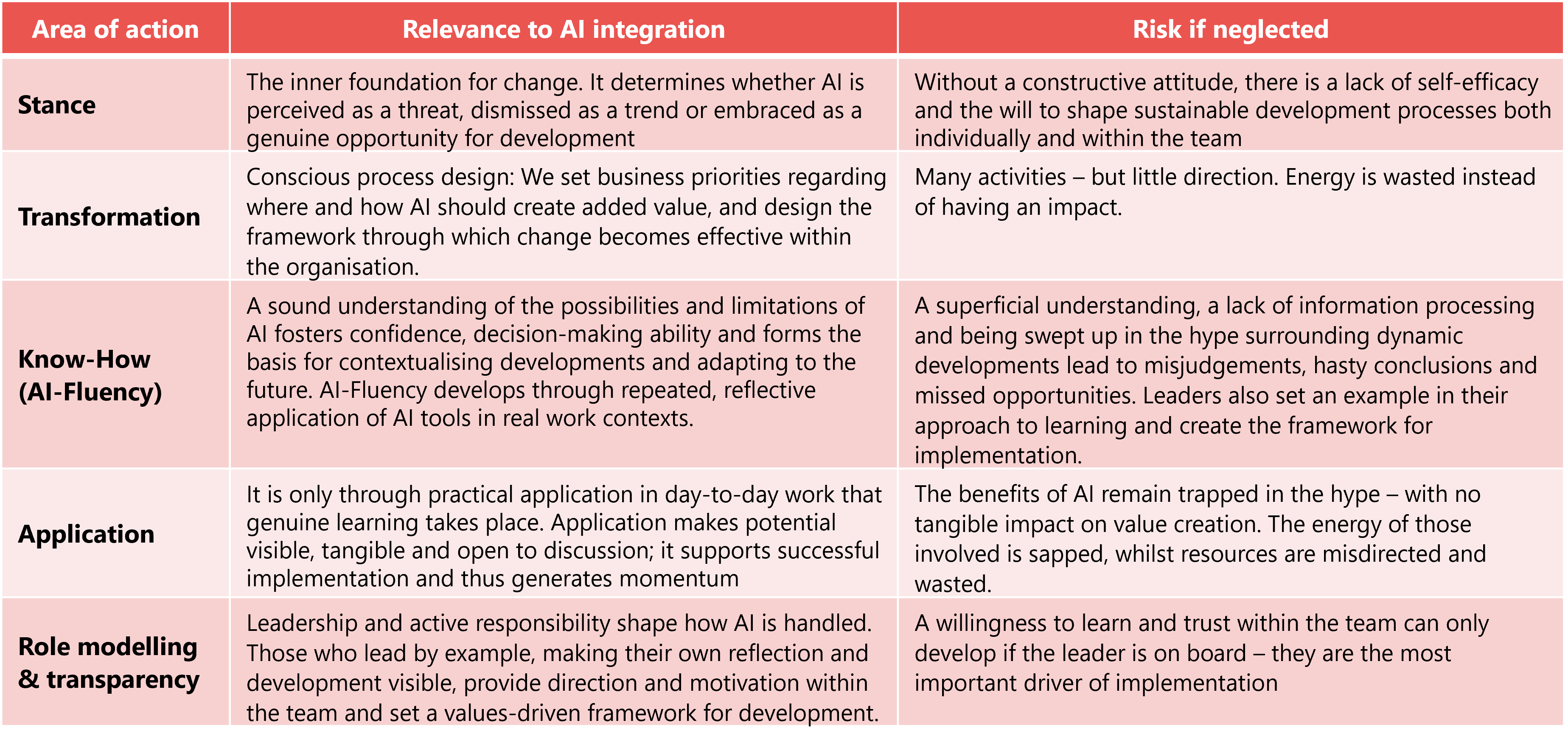
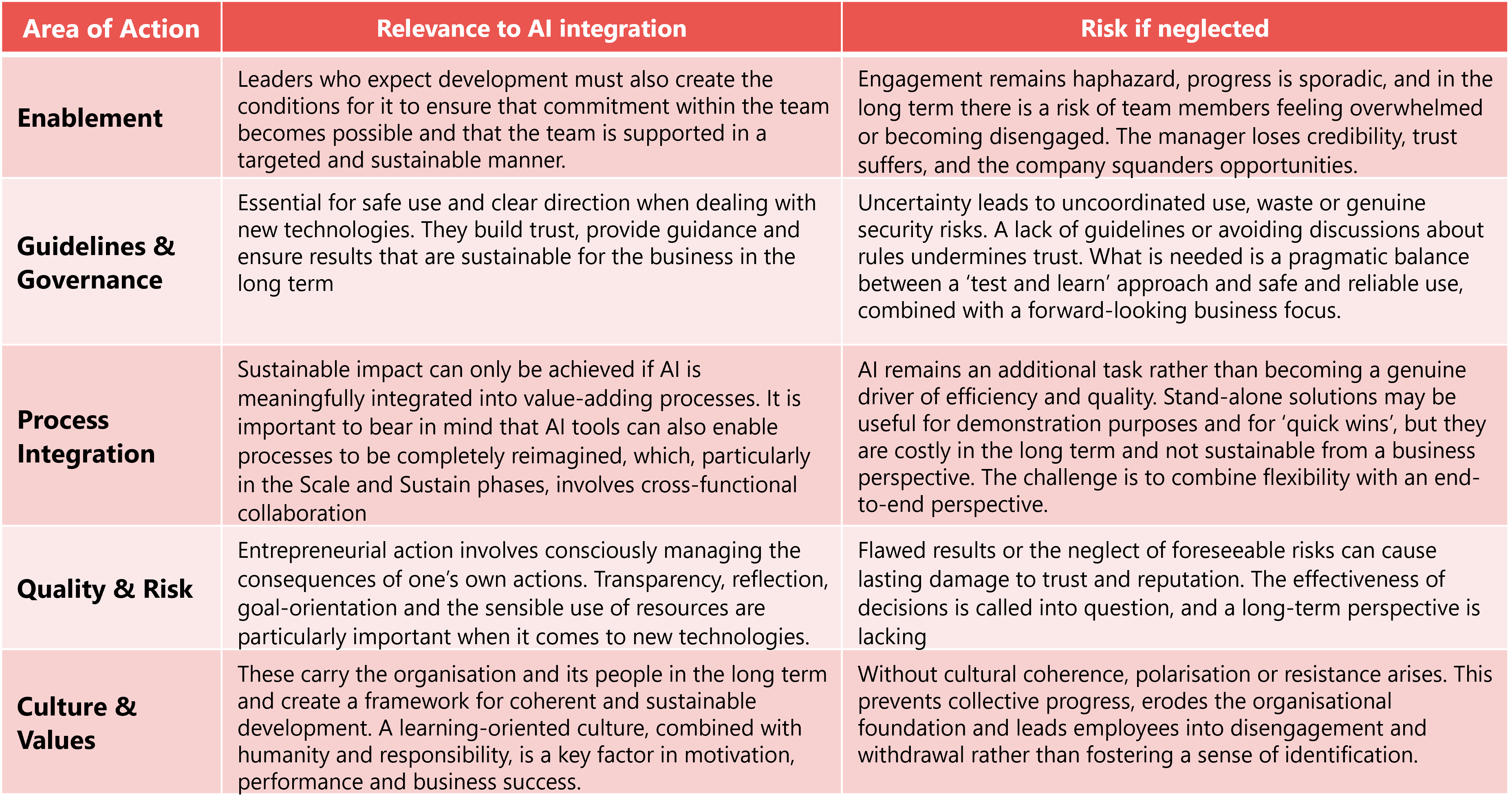
The areas of action should be viewed from two distinct perspectives:
- From the perspective of leaders and their teams: The areas of action serve as a compass in day-to-day work: Where specifically should I adapt my leadership style? What does my team need right now to use AI sensibly, safely and effectively? How do I shape AI integration within the organisation from within my sphere of influence, even across departmental boundaries, and, where necessary, initiate relevant discussions?
- From an HR / Leadership Development perspective (holistic, strategic approach): adopting an analytical view across multiple teams and departments: where are the typical bottlenecks? Which initiatives (formats, learning pathways, communities, process labs) support teams at different stages – and how can skills be developed in a targeted manner? This is where the responsibility lies for linking the top-down approach with the strategic perspective. How do we integrate the perspectives of business (strategy), technology (IT/tools) and people & organisation into a holistic approach?
From a strategic perspective, both viewpoints and a variety of starting points are needed to make progress with AI integration. A purely top-down approach is too slow, whilst bottom-up identification of individual use cases and process optimisation risks becoming piecemeal. Only when leadership at all levels takes responsibility and drives the integration process can the overarching transformation succeed.
Conclusion
The transformation driven by technological development is gathering pace, and people should be the ones shaping it. Perhaps now is precisely the right time for leaders to take a step back and ask: where would AI really make a difference within my area of responsibility, within my organisation? And just as importantly: where would it not? AI is therefore neither a threat nor a short-term trend. It will become a deliberately deployed tool for strategic leadership and transformation. More and more companies are gaining practical experience in implementing AI; our model framework provides guidance and helps to identify critical issues.
An exciting story unfolds and opens up important new fields of action for strategic HR, leadership development and transformation.
Discover more: How can AI become a genuine driver of value creation?
5P works with clients to shape the human and organisational aspects of AI transformation: we clarify changes in leadership, roles and collaboration and – depending on your current situation – provide support through assessments, workshops, process labs, hackathons, training sessions, learning journeys, coaching and sparring, as well as appropriate governance, learning and communication formats.
We have developed an AI-Augmented Leadership Inventory that provides an initial point of reference. The assessment shows you where your leadership, team or organisation currently stands and which next steps will take you forward.
For the moment, this is available in German only. An Englisch adaptation will be available later this year. Please feel free to get in touch with us about this.
E-Mail: sylvia.enders@5p-consulting.com